Google+ Running in Cork, Ireland: Donie Walsh
Showing posts with label Donie Walsh. Show all posts

Saturday, August 14, 2021

50th anniversary of Donie Walsh setting Irish 10,000m record

On the 10th of August 1971, Donie Walsh of Leevale AC set a new Irish record of 28m 52.6s in the European 10,000m championships.

John Walsh has an article in the Evening Echo last Tuesday about it. 

The link is HERE

Thursday, December 07, 2017

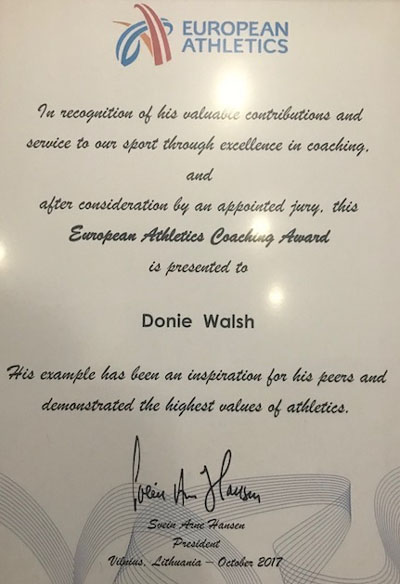
Donie Walsh Receives European Athletics Coaching Award

Leevale AC coach Donie Walsh was presented with an European Athletics Coaching Award recently at the Athletics Ireland Annual Awards.


Donie is one of the top endurance coaches in the country and has been coaching some of the top Irish international athletes for years. At present, he coaches Cork athletes Lizzie Lee and Claire McCarthy amongst others at Leevale AC.


Wednesday, March 08, 2017

Interview with Donie Walsh ahead of the Ballycotton 10

In this interview, John Cashman of C103 gives a brief rundown of the previous winners of the Ballycotton 10 mile road race. He then has a chat with top Irish athletics coach Donie Walsh of Leevale AC who gives his views on the race and some of the top runners ahead of the event next Sunday.


Wednesday, November 23, 2016

Guest Article by John Walshe...DONIE WALSH – NCAA CROSS-COUNTRY 1970

Cork native Donie Walsh of Leevale AC is one of the top running coaches in the country and has been involved in athletics all his life. John Walshe recently wrote an article for the Irish Examiner and the extended version appears below with his kind permission.

DONIE WALSH – NCAA CROSS-COUNTRY 1970
By John Walshe (Irish Examiner, 18/11/2016)

Last Saturday saw the culmination of the American collegiate cross-country season when the 79th NCAA championships took place at Terre Haute, hosted by Indiana State University.

Considering the major impact Irishmen on scholarship have made over the years, it may come as a surprise to learn that just three have come away with the coveted individual title – Neil Cusack (1972), Sean Dolman (1991) and Keith Kelly (2000).


Friday, January 15, 2016

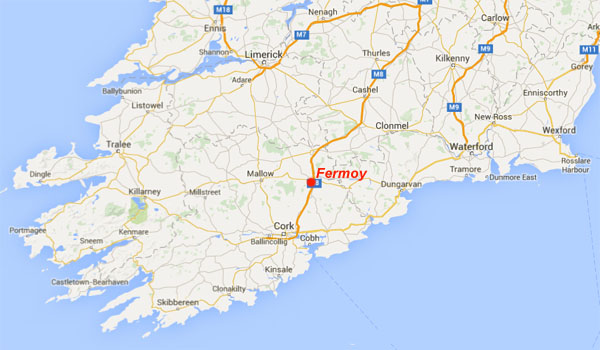
FERMOY'S DECADE OF RACING GLORY... (Guest article by John Walshe)

This weekend in 1976 saw the first of the Fermoy International Cross-Country meetings taking place and an amazing 3000 people turned to witness it. It would continue each year (apart from 1984) until 1987, featuring many of the world's top athletes.
FERMOY'S DECADE OF RACING GLORY... (John Walshe, Evening Echo 14/01/2016)

Forty years ago this Sunday, the sports pages featured Bobby Charlton in the colours of Waterford United who beat St Patrick’s Athletic 3-2 before a capacity crowd at Kilcohan Park.

But on that spring-like January day, an event was taking place in Fermoy which would play a significant role in Irish athletics for the following decade.

The Fermoy International Cross-Country was the brainchild of Tom Burke, then secretary of the Grange club (now known as Grange-Fermoy AC). Like a lot of great ideas – some which never come to fruition - it reputably came about in the early hours of the morning after the club’s annual dinner-dance.

That first race was fixed for Sunday January 18 on the grounds of Patrick Coughlan, situated just outside the town on the right-hand side of the old Dublin road. It was a flat grassland course with a few man-made jumps included for variety and ideal for spectator viewing. The distance was six miles and it was preceded by the Southern Region Junior Championships over four miles.

A number of British clubs had been invited and although Shaftsbury Harriers, Cardiff and Manchester & District Harriers sent teams, for various reasons they were without their star runners. The main attraction was the ginger haired Andy Holden of Tipton Harriers, who tragically passed away two years ago after a long illness.

Holden had competed in the steeplechase four years previously at the Munich Olympics, the same year he set a British record of 8:26.4 for the event. His main opposition was deemed to be Grenville Tuck, one of the famous Tuck twins (the other was Graham) who ran for Cambridge & Coleridge AC.


Grenville Tuck, Neil Cusack & Donie Walsh

The home challenge was led by Neil Cusack from Limerick and Leevale’s Donie Walsh. It was the latter who hammered out a blistering pace from the start, but he lost contact soon after as Holden moved up after a slow start.

Piling on the pressure, the Tipton man eventually crossed the line to a tumultuous reception from the estimated 3,000 crowd in a time of 28:21. Tuck finished runner-up, 10 seconds behind, with Cusack holding on for third in 28:43 and Walsh finishing fourth in 28:56.

Irish clubs dominated the team contest as Clonliffe took first with 62 points, five ahead of the Leevale squad of Walsh, Ray Treacy, Tony O’Leary and Pat Duggan. Donore Harriers finished third ahead of Manchester & District, Shaftesbury and St Finbarr’s.

After that first international, the quality of runners attracted to the Fermoy venue continued to spiral. The following year of 1977, despite a day of strong wind and heavy rain, Bernie Ford from Aldershot (he had finished eight in the 1976 Olympic 10,000m and would go on to run 27:43.74 for the distance later that year) maintained the British dominance when coming home 11 seconds clear of Waterford’s Gerry Deegan.

The 21-year-old Deegan would finish an impressive 21st that spring at the World Championships in Düsseldorf, improving to 14th the following year behind John Treacy’s historic victory in the mud of Glasgow.

Finishing fourth that day in Fermoy was Dutchman Jos Hermens, then holder of the world’s best track times for 10 miles (45:57.6), 20,000m and the one hour run. In later years he became one of the most influential athletes agents with the likes of Haile Gebrselassie and Kenenisa Bekele on his books.

Another former world record holder, Dave Bedford, had to settle for ninth that wet and windswept day, two places ahead of Donie Walsh as the previous year’s winner Holden could only manage 13th. A women’s two-mile race also appeared that year with victory going to Vera Duffy from Glasslough ahead of Ann Ford, wife of the men’s winner.

The following year of 1978, a full juvenile programme was added with the main attraction seeing another British star, Brendan Foster, taking the honours. Now BBC athletics commentator, Foster would later that summer run 27:30.3 for the 10,000m.

Another outstanding athlete who hailed from the same North-East athletics hotbed as Foster was Mike McLeod, the Fermoy winner of 1979. But the following year, the long awaited home success was finally achieved as Deegan took the title, beating Steve Binns and Dave Black from England.

Local star John Hartnett gave the crowd plenty to shout about when taking fourth ahead of Danny McDaid, one of the heroes of the Irish silver-medal winning team at the previous year’s World C-C in Limerick.

In 1981, Deegan had to settle for second behind Hans-Jurgen Orthmann from West Germany and the 1982 race saw McLeod back on the winner’s rostrum after a tremendous duel with Mohammed Kedir of Ethiopia, the winner of the world cross-country a couple of months later in Rome.

The 1983 race was a battle between the world champions with 1977 winner Leon Schots of Belgium defeating John Treacy (1978 and 1979 winner) while another two-time champion, Craig Virgin from the United States (1980 and 1981), could only manage sixth.

One place behind the American was Rob De Castella of Australia who went on later that year to take the marathon title at the inaugural World Championships in Helsinki as well as defeating Alberto Salazar and Carlos Lopes at the Rotterdam Marathon.

Another iconic world star was Henry Rono, the Kenyan who had set world records for 3000m, 5000m, 10,000m and 3000m steeplechase during the early summer of 1978. But by the time of his Irish appearance nine years later he was past his best, finishing well down the field as Limerick’s Frank O’Mara won the final Fermoy International Cross-Country.

Sadly, the decade that brought a galaxy of stars to the North Cork town was at an end, but it is an era that is fondly recalled by those who were fortunate enough to be part of what was truly an international feast of world-class athletics.

Thursday, January 30, 2014

Guest article...Cork Cross Country Victory of 1974

The following article was written by John Walshe for the Evening Echo and is republished here with his kind permission.

CORK CROSS-COUNTRY VICTORY OF 1974...By John Walshe (Evening Echo, Tuesday January 28th 2014)

It’s been all of 13 years since a Cork team last won the National Senior Inter-Counties Cross-Country Championship. In that period Dublin have won an amazing 11 successive titles and look set to continue that trend for the near future.

Things were different 40 years ago and this month marks a famous Rebel victory which took place at Mallow Racecourse on January 27, 1974. It was a day also notable for the conditions endured and the individual win by a man who is still very much involved in the local athletics scene here in Cork.

All Ireland Cross Country Championships at Mallow race course

The weather during all of January 1974 was something akin to that experienced in recent weeks, with heavy rain and storms an almost daily occurrence. As competitors and spectators made their way to Mallow on that Sunday morning, the bright sunshine had given way to steady rain. As time moved on to the main attraction of the day, conditions continued to deteriorate.

Deirdre Foreman had led Dublin to an easy team win in the opening race which saw the Mellerick sisters from Fermoy – Maura and Dervla – finish fourth and fifth. As the 170-strong men’s field toed the line, they faced the prospect of seven-and-a-half miles of heavy and undulating terrain in torrential rain and gale-force winds.

Donie Walsh of Leevale
On the second lap of five, Danny McDaid, Tom O’Riordan and Des McGann had prised open a slight gap on the large chasing group. Shortly after, they were joined by the ominous figure of Cork’s Donie Walsh.

Like McDaid and McGann, the Leevale man had run the Olympic marathon a year-and-a-half before though the streets of Munich and was now back living and working in his native city after a four-year scholarship at Villanova.

Passing the racecourse’s grandstand for the third time, Walsh took the lead and stayed in front for another mile, before McCann, running the race of his life, drew level. As conditions continued to worsen, the pair ran shoulder to shoulder until a surge by Walsh proved decisive, gaining him a vital 20 yards advantage.

McCann tried all he could to regain contact but the 26-year-old Corkman was not to be denied in front of his home crowd and eventually crossed the line with 13 seconds to spare over the gallant Meathman with O’Riordan, representing Kerry, just another five seconds back in third.

Every bit as exciting as the individual battle was the team contest and when the points were tallied up, Cork had come out victorious by seven points (89 to 96) over Galway with Dublin third on 174. The Cork scoring sextet were: Donie Walsh (1st), Richie Crowley (8th), Freddie Down (14th), Finnie Long (15th), Dick Hodgins (24th) and Denis Manning (27th).

As the victorious Cork team made their way home amidst the rising floodwaters around the town of Mallow, they were able to reflect on a famous victory achieved in the most appalling of conditions.

But for Donie Walsh, it marked the end of a remarkable month of January that had produced four brilliant achievements the likes of which wouldn’t even be contemplated nowadays by any of our full-time athletes.

On the first Saturday of the month, along with colleagues Tony Shine and Tim Donovan, Walsh had travelled by train to Belfast where he won the prestigious Miskimmon Cup cross-country over a very tough six-mile course.

The following day, he was back in Ballincollig for the Cork senior championship which, like all championships at the time, was over a distance of seven-and-a-half miles. A steady start saw Walsh back in 10th position in the early stages as clubmate Ray Treacy set a gruelling pace but after two miles Walsh – wearing his familiar headband – had opened up a gap on his nearest challenger, Richie Crowley of St Finbarr’s.

At the finish, the margin of 15 seconds was sufficient to give Walsh another title ahead of Crowley with Finnie Long holding off Treacy for third. Leevale easily took the team title on 41 points, 14 ahead of St Finbarr’s, with the scorers being Walsh (1st), Treacy (4th), Gene Mealy (5th), Dick Hodgins (8th), Jerry Murphy (9th) and Wally Young (14th).

Two weeks later, January 21, was the day of the Quinlan Cup road race at Tullamore. Road races today may revolve around times and accurate distances, but Tullamore was all about competition. Winners over the years would read like a who’s-who of Irish running with the likes of Eamon Coghlan, John Treacy, Ray Treacy and John Hartnett tasting victory around the streets of the Midland town.

For once in that month, conditions were good as the huge field of around 400 headed off on a course of approx 11,000 metres (the acronym ‘10k’ had yet to be invented). Six runners broke away shortly after the start – Walsh, Crowley, McGann, Paddy Murphy, Tom O’Riordan and his namesake, Pat O’Riordan. The latter, also a Leevale man, soon suffered an injury and had to drop out.

This was the signal for Walsh to take the lead and in a fiercely contested last mile he withstood the tremendous challenge of the chasing bunch to reach the sanctuary of the tape just six seconds ahead of former winner and fellow Corkman, Richie Crowley. Murphy, from Kildare, took third with McGann fourth, John Scanlon from Galway fifth and journalist Tom O’Riordan sixth.

Walsh’s performance no doubt inspired his clubmates and despite Pat O’Riordan’s mishap they packed magnificently to take coveted Quinlan Cup ahead of holders Donore on a scoreline of 69 points to 100 with Clonliffe third on 151. Those six Leevale scorers were Walsh (1st), Dick Hodgins (9th), Ray Treacy (10th), Pat Duggan (14th), Gene Mealy (16th) and Tony O’Leary (19th).

The headline on the Cork Examiner the following day read ‘Day of glory for Walsh and Leevale’, and so it was. And there was to be further glory for Walsh the following month at Tuam Racecourse when, on February 24, he retained his BLE Inter-Clubs crown ahead of Joe Scanlon, Fr Paddy Coyle and Danny McDaid.

However, Donore gained revenge over Leevale when taking the team title by nine points, 33 to 42. Remarkably, given all their achievements over the four decades since, it’s still the one national honour that has eluded the Cork club.

Tuesday, January 17, 2012

Looking back 40 years...Cork X-Country 1972

This article was written by John Walshe and appeared in the Evening Echo at the start of 2011. This month is now the 40th anniversary of this particular race and the article is re-produced here with John's kind permission...

John Hartnett, John Buckley and Donie Walsh

40 YEARS AGO - MEMORABLE CORK CROSS-COUNTRY CHAMPIONSHIP
By John Walshe (Evening Echo)

On the first Sunday of January 1972, the Cork BLE senior, youths and women’s cross-country championships took place at Grange, outside Fermoy. It was a meeting eagerly awaited by athletics fans as it featured a showdown between three of Cork’s greatest-ever distance runners - John Hartnett, Donie Walsh and John Buckley.

The reason that the championships were held so late in the season was to facilitate the afore-mentioned Hartnett and Walsh who, along with Billy Bolster, were home on holiday from their respective American universities. Hartnett and Walsh attended Villanova and both came with impeccable cross-country pedigrees.

In March 1970, Hartnett had won the International Junior title at Vichy in France while later that year Walsh finished second to the legendry Steve Prefontaine at the NCAA championships. Five months before that Grange fixture, Walsh had also set an Irish 10,000m record of 28:52.6 at the European Championships in Helsinki.

Buckley did not chose the scholarship route, instead remaining at home where he carved out a special niche for himself on the cross-country circuit. At the age of 19 the St Finbarr’s man was already a county senior champion and in March 1969 he had the distinction of beating the then Olympic 5,000m champion, Mohammed Gammoudi, at the International Military Championships held at Ballincollig.

So, in ideal conditions, the scene was set for an epic encounter before a large attendance at the well laid-out course outside Fermoy. But first, two other county championships had to be decided. The youths (under-18) race was over three miles and here victory went to Gene Mealy of Leevale who led home John McSweeney (Blarney) and Denis Hartnett, brother of John, from Grange. In fourth was Tim Goulding (Ovens) and two places behind came a future Olympian, Liam O’Brien from Midleton.

Mealy – now the South-Western Regional Secretary of SIPTU – was backed up by Michael Carey, Pat Duggan and Brian O’Neill and they led Leevale to what would turn out to be a clean sweep of team titles as they defeated Grange by nine points with St Finbarr’s taking third.

Maire Buckley, who had finished second in the All-Ireland Intermediate Championship, added the County Senior title in impressive fashion with Joan Fleming (St Finbarr’s) and Tracy Roche (Grange) taking silver and bronze. In a close team contest, Leevale again packed well to defeat St Finbarr’s by just three points. Buckley was ably backed up by Mary Crowley (4th), Freda Horgan (9th) and Alison O’Keeffe (10th).

As the field of 61 toed the line for the start of the 7½ senior race, all eyes were on local man Hartnett. From the gun, the pace was fast with the 22-year-old Grange athlete at the head of affairs. Already, runners were strung out with only Buckley, Bolster, the St Finbarr’s pair of Ritchie Crowley and Finbarr Long, and Hugh Parnell of Leevale managing to stay in contact. Walsh, who had been out of competitive action with a leg injury for a month before, was dramatically back in 10th place and his chances of retaining the title had vanished. 

Into the second mile, Hartnett had shaken off all except the resolute Buckley who astonishingly was managing to stay in his shadow. For the next four miles they ran shoulder to shoulder with Buckley even applying the pressure on a number of occasions as Hartnett suffered briefly from a stitch. But with a mile to go the Grange star put in a hard surge while negotiating a climb and Buckley’s gallant challenge faded, leaving Hartnett to cross the line with around 100 yards to spare after 36 minutes and 38 seconds of running.

Walsh – as he did so often in a glittering career – finished stronger than everyone else to take the bronze with Crowley fourth and Long (winner of the Youghal Round-the-Houses five-mile race two nights before) in fifth. With Parnell running out of his skin in sixth position, further superb packing by Leevale saw Pat O’Riordan, Jack O’Callaghan and Tony O’Leary take seventh, eight and ninth positions with their final scorer, Dick Hodgins, making a comeback after injury, closing in the team in 11th. It had been one of the great days in the annals of the Leevale club and, as the Evening Echo reported on the following Wednesday, the three cups were duly filled in Pa Johnson’s Pub that Sunday night. 

For the three main protagonists, that Olympic year of 1972 brought varying fortunes. Shortly after returning to America, Hartnett ran indoor times of 8:35 for two miles and 13:29 for three. Later in the year he established an Irish 5,000m record of 13:43.0 when finishing ninth behind Dave Bedford’s European record of 13:17.2 in the AAA Championships at Crystal Palace.

In Munich, suffering from injury, he was eliminated in the heats of the Olympic 5,000m. He would go on break Ronnie Delany’s Irish mile record with a time of 3:54.7 and on a memorable night run a mile in 3:56.3 on the old Mardyke grass track at the Cork City Sports.

Walsh also suffered injury problems on his return to Villanova and just missed out on the Olympic qualifying time for the 10,000. Deciding to go for the marathon instead, he targeted the Irish championships in Athlone which he won in an outstanding 2:15:21. At Munich, despite suffering from ‘flu symptoms, he gamely tried to go with the leaders before drifting back to finish 47th in 2:31.

For Buckley, the fact that he was able to stay with Hartnett for so long showed the form he was in. He duly won the BLE National C-C at Clonmel to add to the Southern Region and Inter-Counties he had already won that season. The International (now World) Championships were held in March at Cambridge and there Buckley finished sixth of the Irish team in 62nd position.

Remarkably, the following day he turned out in another cross-country race organised by the London-Irish club at Parliament Hill Fields and ended up only 11 seconds behind John Bicourt of Belgrave Harriers, one of Britain’s representatives later that year in the Olympic 3000m steeplechase.

Tuesday, September 28, 2010

John Hartnett plaque unveiled in Ballyhooly, Co.Cork

Approximately 30 people gathered in Ballyhooly, Co.Cork last Friday evening to attend the unveiling of the special plaque commemorating the athletic achievements of John Harnett.

Donie Walsh of Leevale AC did the honours of unveiling the plaque after a short speech recounting part of his time in the USA with John. Back in the 70's, both were running to such a high standard that they represented Ireland in the 1972 Olympics in Munich, Donie Walsh in the Marathon and John Hartnett in the 5,000 metres.

There are some photos of the plaque as well as a history of John Hartnett available HERE


Also shown on that page is a black & white photo taken of a cross-country race in the USA back in 1971. Pictured on the right is Donie Walsh, John Hartnett is in the centre and on the left in the Manhattan singlet is Mike Keogh who grew up in Midleton and then moved to the USA when he was still a child.


Mike Keogh qualified for the Irish Olympic team of 1972; he came back to Cork that summer and won the Irish 5000m championship at Banteer. He also broke the Irish three-mile record a couple of years later with a time of 13:14.7.

He is pictured (in a Midleton vest!) on page 17 of the Midleton AC book ‘Through the Ages’ published by Jim McMurtry earlier this year.

Wednesday, September 22, 2010

Unveiling of plaque to John Hartnett - Ballyhooly - Fri 24th of Sept 2010

No doubt many of you will have heard of the 'John Hartnett Challenge' race which takes place in Ballyhooly near Fermoy in N.Cork every August. The numbers attending for the last 2 years have been small but it has certainly lived up to it's name with a hilly and tough 10 mile course.

When I first heard of the race in 2009, I have to admit that I had no idea of who John Hartnett was or what he had done. I think at one stage, I had put the race up on the calendar of Cork road races as the John Hartnett Memorial race before someone pointed out that he was still alive and well and living in the USA!!

Oppps! ;o)

Prior to the event this year, one of the race organizers, Pat Nash sent on some information to me about John Hartnett. At the time, I put the info to one side and it's only recently that I have had a chance to read through it. John Hartnett from Cork was a world class runner in his day and ran some really impressive times back in the early 70's. He set new Irish records for the mile beating previous times set by Ronny Delaney. If that wasn't enough, the time he ran was also faster than the existing British record for the mile! He also represented Ireland in the 5,000 metres at the Olympic games in Munich in 1972.

When I turned to the Internet and Google for information on John Hartnett, there seemed to be very little out there. It seemed a shame that such a good Irish runner should be overlooked and forgotten about.

So to remedy that, I have put up a few webpages about John Hartnett up on a website so at least there is a small corner of the web where people can read about him and his achievements. You can see the start of the article HERE.

Towards the end of the article, there is a photo from 1971 showing John Hartnett and Donie Walsh who was a fellow team mate at the time from Villanova in the USA. Donie also went to the 1972 Olympics to represent Ireland in the Marathon and is currently a coach with Leevale AC.

On Friday the 24th of Sept at 7pm, that picture which was taken back in 1971 kind of goes full circle when 39 years later, Donie Walsh will be unveiling a special plaque in the village of Ballyhooly to commemorate John Hatnett.

This is open to the public and if you are interested in attending, you can see the exact location HERE

Ballyhooly is on the N72 main road between Fermoy and Mallow. If you are coming from Cork City, go into the centre of Fermoy, cross the bridge and take a left at the church with the statues outside. Stay on this road and you will arrive in Ballyhooly.

Refreshments will be served in the GAA hall after the unveiling.